
Impact
From a single community development corporation to a three-entity Constellation.
The Summer Walk · 2026
A summer of youth development, week by week.
Nine weeks. From the microphone to the prairie, the garden to the college campus — Standing Rock youth spent the summer building confidence, culture, and skills for the road ahead.

The seventh generation is here.
Week 1 · Welcome + Orientation
The summer begins in a circle. Thirty youth relatives — mentors and mentees from across the districts of the Standing Rock Nation — learn each other's names, hear what the summer will ask of them, and receive the first teachings: who we are, why this organization exists, and what it means to earn a place in the work.
Orientation & Welcome
The executive team and the Youth Development Initiative Manager welcome the cohort — meeting mentors, setting intentions, and praying the season in.
Week 2 · Building the Team
June 8–11Trust is built before anything else is. Mentor and mentee pairings take shape, the first working circles form, and thirty individuals begin becoming one cohort — the relationships that will carry every week that follows.
First Aid & CPR Training
The first credential of the summer — youth trained in First Aid and CPR, ready to help when it counts.
Food Handlers Training
A Food Handlers certification — safe hands for the kitchen and the community feeds ahead.
Guest Speaker Session
A guest speaker spent the day with the cohort.
Garden Basics
Soil, seeds, and the first lessons of growing food — the foundation for the harvest to come.
Week 3 · Culture + Language
June 16–18Hands in the soil and real skills for real wages. The garden goes in and sage is gathered the right way, while financial literacy and budgeting lessons put a paycheck and a plan in the same hands — money sovereignty taught alongside the old ways.
Financial Literacy & Budgeting
The tools to build and hold wealth at home — budgeting, saving, and planning ahead.
Garden & Sage Picking
Tending the garden and picking sage — food and medicine, side by side.
Week 4 · Community + Voice
June 22–24Youth step to the microphone, building the confidence to speak for themselves and for the people. The Dakȟóta language introduction puts the words of our grandparents in young mouths, and community cleanup and tipi raising turn that voice into work that serves.
Community Clean-Up
Caring for the places we share.
Public Speaking
Youth stepped to the microphone — building the confidence to speak for themselves and for their people.
Dakȟóta & Lakȟóta Introduction + Tinpsíŋna Digging
A day on the land: an introduction to the language, and digging tinpsíŋna — wild prairie turnip — the way it has always been done.
Week 5 · Land + Teachings
June 29 – July 2Time on the land as it has always been done — elder-guided sessions and the teachings the land itself carries. Career Development Day points each young person toward a future, and beading asks of them what it has always asked: patience, precision, and beauty — the old arts in young hands.
Career Development Day
Meeting professionals and imagining the paths ahead — what a future can look like, close to home.
Beading
Patience, precision, and a craft carried through generations.
Mentor–Mentee Check-In
Sitting down together — checking in on growth, goals, and the season so far.
Week 6 · Health + Leadership
Caring for the body that carries you, and practicing the roles they were born for. Health training, leadership activities, the garden tended through the heat of the summer, and time spent sitting with the elders who know.
Garden — Elder Engagement
In the garden with our elders — knowledge passed hand to hand.
Leadership Activities
Teamwork, problem-solving, and finding one's voice within the group.
Health Training
Caring for the body as part of caring for the whole.

Caring for the body that carries you.
Week 7 · Identity + Wellness
What our old people taught about responsibility to each other. Traditional roles and teachings, mental health awareness — because strength includes asking for help — and the first of the garden harvest coming home.
Garden Harvesting
Harvest day — youth gathered fresh greens from the hoop-house garden, soil to table.
Gender Roles
An honest conversation about roles, respect, and healthy relationships.
Mental Health
Tools for resilience — and for caring for one another.

Strength includes asking for help.
Week 8 · Bringing It Together
Food ways and craft ways, preserved by practice: wasna making, chokecherry picking, medicine pouch making. A walk through Sitting Bull College closes the week — the campus where many of them will study.
Long Soldier Powwow Grounds
Preparing the powwow grounds — readying the space for the people to gather.
Medicine Pouch Making
Carrying protection and prayer close.

Protection and prayer, carried close.
Sitting Bull College Visit
Walking a college campus and picturing themselves there.

One day, this campus is theirs.
Chokecherry Picking
Gathering chokecherries the way the season gives them.
Wašná Making
A traditional food, made together.
Week 9 · The Summer Comes Home
Serving the people at the Long Soldier powwow grounds. Lacrosse in Bismarck — the Creator's game, played hard. And a STEM day at United Tribes Technical College, where the seventh generation builds forward.
Lacrosse
Playing the Creator's game.
UTTC STEM Activity
A hands-on STEM session with United Tribes Technical College — science you can hold in your hands.
Photographs shared with the consent of the families and the community. The Youth Development Initiative runs each summer across the districts of Standing Rock.
Impact Beyond Our Borders
The Story Travels.
Impact is not only what we build — it is what we help others begin.
Over the past decade, visionaries from more than ten relative Indigenous nations have come to Seven Stones with the same question: how do we build this for our own people? Each time, our founders sat with them, shared the story of how this organization came to be — the vision, the paperwork, the hard first years — and encouraged them to begin. Where it was needed, we carried emerging organizations as a fiscal sponsor until they could stand on their own.
Today, those nonprofits serve their own nations, in their own ways, under their own names. That is what our mission means by relatives of all directions: sovereignty is not a resource we guard. It multiplies when it is shared.
Community Voices
In our community’s own words.
“I've taken a business here from heavy debt to debt-free and flourishing — so I know what our people can build when we own it ourselves. That's why I chair this board: to see the best for Standing Rock, and real opportunity for the ones coming up.”

“Identity first. Nation first — who we are, and who we belong to, before anything we do.”

“I got paid to learn who I am — and that I am the seventh generation my great-great-grandparents prayed for.”

More voices from across the eight districts join here as they are gathered and shared with permission.
The Standing Rock We Serve
The conditions we work in.
None of these numbers are ours alone — they are documented in our Nation’s own planning: the Standing Rock Sioux Tribe’s Comprehensive Economic Development Strategy, the housing study our organization commissioned with community partners in 2019, and the lender-grade housing feasibility work we completed in 2026. We publish them here because our partners and funders deserve to see exactly what we see when we decide what to build next.
Poverty & work
- 44% of all residents — and 57% of children — live below the poverty line, more than double the national rate.
- Median household income is $41,843 — roughly half the U.S. median of $81,604.
- Per capita income is $19,930 — half the U.S. average, among the five lowest per-capita-income places in the country.
- Half of the workable population is unemployed.
- 22% of our elders live below the poverty guidelines.
- Roughly 50 cents of every dollar earned is spent off the reservation almost immediately.
Housing
- A documented structural shortage of roughly 1,030 housing units reservation-wide over the next 5–10 years.
- 2,179 households share 2,636 housing units across 2.3 million acres — the documented shortage breaks down to a 630-unit functional deficit today, plus 200 units of workforce need and 200 units of coming household growth.
- The average home here is worth $79,600 — about one quarter of the U.S. average.
- Only 4% of homes have been built since 2021; most “vacant” units are actually uninhabitable.
- 11.7% of occupied homes are overcrowded — about four times the national rate; 60.5% of households had members who wanted a home of their own.
- 95.5% of surveyed residents said finding affordable, quality housing to buy is challenging.
Banking access
- “No bank” is the #1 weakness in the Tribe’s own current CEDS analysis.
- 48.2% of surveyed residents had no checking account; 63.5% had no savings account.
- Only 237 of 1,164 owner-occupied homes on the reservation carry a mortgage — home lending barely exists here.
- Trust land cannot be used as conventional collateral — a structural barrier the CEDS itself names.
- Money that cannot stay, grows nothing: the Tribe’s own analysis names economic leakage — dollars leaving the reservation almost as fast as they arrive — among its central threats.

The Pattern
These are not three separate problems. They are one pattern: when there is nowhere to live, workers cannot stay. When there is no bank, savings cannot grow and homes cannot be financed. When money cannot stay, businesses cannot start — and the talent our Nation raises leaves to build somewhere else. Our Tribe’s own economic strategy names housing as the single largest constraint on workforce recruitment, retention, business growth, and the long-term exercise of tribal sovereignty.

What the Land Holds
The same strategy documents what the deficit numbers never show: 2.3 million acres of land. A workforce carrying the trades — construction, heavy equipment, electrical, plumbing. A tribal college coordinating transit across the whole reservation. Young people in every district. And what the CEDS itself lists among our Nation’s greatest strengths: our people, our prayer, and our Dakȟóta/Lakȟóta values and language. The need is real. So is everything we have to answer it with.
Why We Build What We Build
Every program and project in this organization is an answer to a line in these studies. The documented shortage of more than a thousand homes is why housing development anchors our work — beginning with the 108-home master plan at Dream Hills (Wihaŋbda Sa Hills) in Cannon Ball — duplexes and mixed-use apartment homes, built in phases on land our organization owns — the proof that our community can plan, finance, and build for itself. The Tribe’s own analysis that names “no bank” as its first weakness is why our Constellation includes an emerging community lender. The half of every dollar that leaves is why we develop community-owned assets that keep value home. We did not choose our work by preference. We chose it by reading what our Nation wrote about its own needs — and answering.
“A handful of Standing Rock community members decided that the power we had witnessed in our people deserved permanent institutions.”
— Loretta (Grey Day) Bad Heart Bull, Co-Founder, Corporate President & Board Member
Upcoming · End of Summer
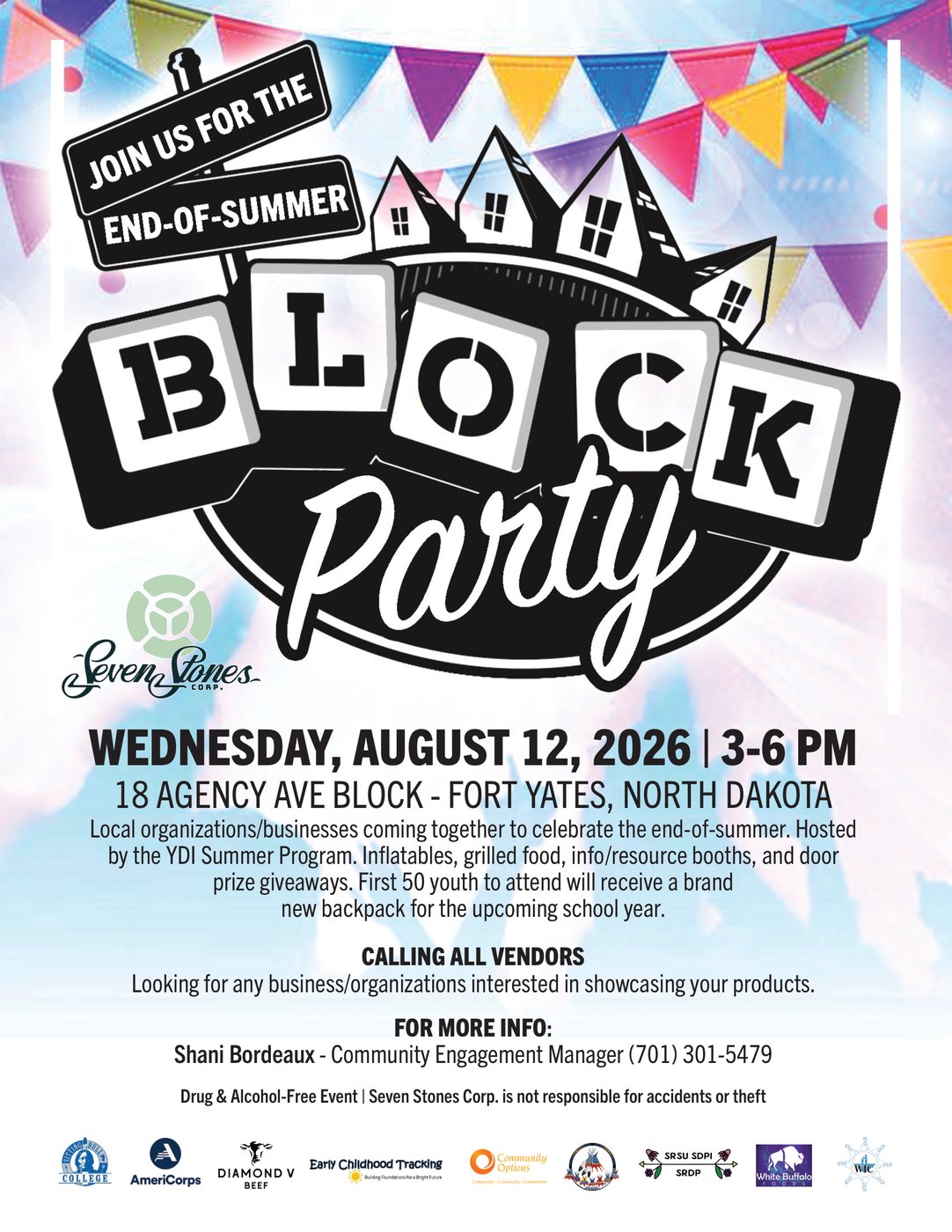
Community Block Party
Wednesday, August 12, 2026 · 3–6 PM · 18 Agency Avenue, Fort Yates, North Dakota
Local organizations and businesses come together to celebrate the end of summer, hosted by the YDI Summer Program — inflatables, grilled food, info and resource booths, and door-prize giveaways. The first 50 youth to attend receive a brand-new backpack for the school year. A drug- and alcohol-free event.
Vendors welcome — to showcase your business or organization, contact Shani Bordeaux, Community Engagement Manager, (701) 301-5479.
In the Works
The Dakȟóta/Lakȟóta Cookbook
From the garden to the table: a collection of our recipes and food ways — each written in Dakȟóta/Lakȟóta and English. Still in draft; here is a sneak preview. Turn the pages.
How We’re Answering
Why We Build
Our Nation has told its own story in its own planning documents. Every few years the Standing Rock Sioux Tribe publishes a Comprehensive Economic Development Strategy — an honest accounting of where we stand. The current one says what our families already know: nearly half our people live below the poverty line, and more than half our children. Half the workforce is without work. Half of every dollar earned here is spent somewhere else almost as soon as it is earned, because the businesses, the housing, and the bank that would hold those dollars close have never existed here.
The same documents name what is missing. There is no bank on Standing Rock. Home lending barely exists — of more than a thousand owner-occupied homes on this reservation, fewer than one in four carries a mortgage. And the Tribe’s own strategy calls housing the single largest constraint on our Nation’s future: our workforce, our businesses, and the long-term exercise of our sovereignty.
That is why Seven Stones exists — and why one organization grew into three. A nonprofit that carries programs for our youth, our food, our language, and our communities. A real estate arm that builds and holds property so that opportunity has an address here at home. And a community lender in formation, so that one day a family at Standing Rock can walk into an institution owned by its own people and leave with the keys to their future.
We do not claim to have solved these things. We are building the institutions our Nation has never had — season by season, home by home, family by family. This is where that work stands today.


